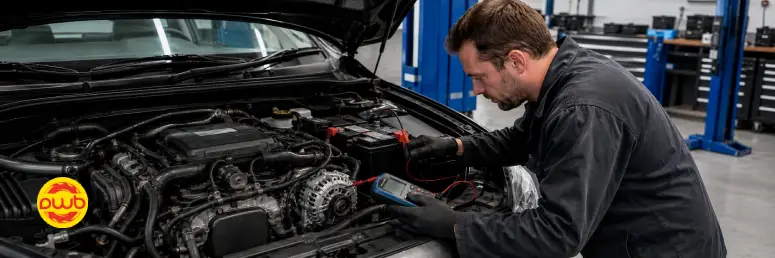
If your car struggles to start, the battery is usually the first component to check. If it starts with a jump but later stalls, repeatedly drains a healthy battery, or develops electrical problems while the engine is running, the alternator or charging system becomes more suspicious. Proper testing is still required before replacing either part. Read more in this blog on DWB Tyres.
The two faults are easily confused because they are connected.
The battery supplies the large burst of electrical power needed to start the engine. Once the engine is running, the alternator supplies electrical power and recharges the battery.
A failing alternator can therefore leave you with a flat battery even when the battery itself was originally healthy. AAA notes that battery and alternator symptoms frequently overlap and professional testing may be required to identify the actual fault.
Battery vs Alternator at a Glance
Battery vs Alternator at a Glance
The timing of the problem provides one of the best clues: battery faults are often most obvious while starting, while alternator faults usually become clearer after the engine is running.
Signs Pointing to the Battery
Slow Engine Cranking The starter turns the engine more slowly than normal, particularly after the car has been parked.
Rapid Clicking When Starting There may not be enough battery power available to operate the starter properly.
Starts With a Jump and Keeps Running A discharged or weak battery becomes more likely, although the charging system should still be tested.
Signs Pointing to the Alternator
Battery/Charging Light While Driving This commonly indicates a charging-system problem rather than simply telling you the battery is old.
Car Starts but Dies Again If the engine starts after a jump and then stalls shortly afterwards, charging-system failure becomes more suspicious.
Electrical Problems While Running Flickering lights, weak accessories or repeated battery discharge can indicate inadequate charging.
These symptoms help narrow down the problem but do not prove which component has failed. Battery condition, charging output, cables and connections should be tested before parts are replaced.
What Does the Battery Do and What Does the Alternator Do?
The battery and alternator perform different jobs.
Car Battery
The battery provides electrical power before the engine starts.
Its biggest task is supplying the high current required by the starter motor to crank the engine.
The battery also powers electrical systems when the engine is switched off.
Alternator
Once the engine is running, the alternator generates electricity.
It supplies the vehicle's electrical systems and replenishes the battery charge used during starting.
AAA describes the alternator as the component that keeps the battery charged while supplying electrical power when the engine is operating.
This relationship explains why diagnosing these problems can be confusing.
A bad battery can prevent a perfectly good alternator from ever getting the engine started.
A bad alternator can gradually discharge a perfectly good battery.
What Are the Signs of a Bad Car Battery?
A battery problem usually becomes most obvious before or during engine starting.
Slow Engine Cranking
The engine turns over, but noticeably more slowly than normal.
This can happen when the battery can no longer supply sufficient starting current.
If the symptom is becoming progressively worse, battery condition should be tested.
Rapid Clicking When You Try to Start
Rapid clicking often occurs when there is enough electrical power to operate the starter solenoid but not enough to crank the engine properly.
AAA identifies rapid clicking as a common clue to insufficient battery power.
However, do not diagnose the battery from sound alone.
Loose or corroded terminals can produce similar starting problems.
The Car Needs Repeated Jump-Starts
One accidental flat battery can happen because:
- lights were left on;
- the vehicle was parked for a long period;
- an accessory remained powered;
- or another temporary drain occurred.
- Repeated jump-starts are different.
If the battery repeatedly loses charge without an obvious reason, either:
- the battery is no longer holding charge;
- the alternator is not charging it correctly;
- or another electrical drain is present.
- Battery Terminals Are Corroded or Connections Are Loose
Poor connections can imitate a bad battery.
A battery may be healthy but unable to deliver current properly because of:
- terminal corrosion;
- loose clamps;
- damaged battery cables;
- or poor ground connections.
AAA specifically warns that faulty or corroded connections can mimic battery or alternator failure.
The Battery Case Is Swollen
A swollen or visibly damaged battery should not be treated as a normal flat battery.
Do not attempt casual jump-starting if the battery appears significantly swollen, leaking or physically damaged.
Arrange professional inspection instead.
AAA warns against jump-starting a swollen battery because of the risk associated with a damaged battery case.
What Are the Signs of a Bad Alternator?
Alternator problems often become clearer after the engine has started.
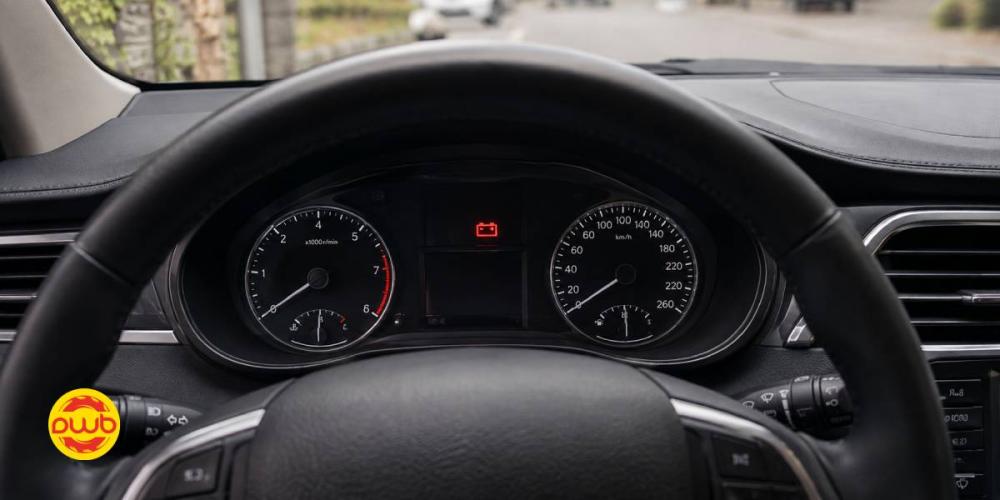
Battery-Shaped Warning Light Comes On While Driving
This warning light is commonly misunderstood.
The battery symbol on the dashboard does not necessarily mean “replace the battery.”
It usually warns that the vehicle's charging system is not operating normally.
The alternator, drive system, wiring, regulator or another charging-system component may be involved.
AAA similarly notes that the battery warning lamp commonly indicates an alternator or charging-system problem.
Headlights or Interior Lights Flicker While the Engine Is Running
If electrical output becomes unstable while driving, you may notice:
- headlights changing brightness;
- dashboard lights flickering;
- infotainment resetting;
- power windows slowing;
or other electrical accessories behaving irregularly.
These symptoms can occur when the alternator cannot provide stable charging output.
DWB already covers related symptoms in its article about car electrical issues.
A Good Battery Keeps Going Flat
Replacing the battery does not repair a bad charging system.
If a relatively healthy or recently replaced battery repeatedly goes flat, test the charging system before replacing another battery.
A failing alternator may not restore the energy used during each engine start, causing the battery's state of charge to decrease over time.
Engine Stalls While Driving
A serious alternator failure can eventually cause the vehicle to lose enough electrical power that the engine can no longer continue operating.
AAA notes that alternator failure can lead to engine stalling when sufficient electrical power is no longer available.
If the charging warning light appears and the vehicle begins losing electrical functions, do not assume you have enough battery reserve to drive for a specific distance.
How long the vehicle continues running depends on the car, battery state, electrical load and type of fault.
Car Starts With a Jump but Dies Again — Battery or Alternator?
If the car starts after a jump-start but dies shortly afterwards, an alternator or charging-system problem becomes more likely.
Here is why:
The jump source provides enough power to get the engine running.
Once the jump source is disconnected, the vehicle should normally receive electrical power from its own charging system.
If the alternator is not producing enough power, the vehicle continues running only on the remaining battery charge. When that charge falls too low, the engine may stall.
AAA describes this start-after-jump-then-die pattern as a classic clue to alternator failure.
But it still is not absolute proof.
Problems involving:
- charging cables;
- alternator belt drive;
- electrical connections;
- grounds;
- or other components
can create similar behaviour.
The charging system should be tested.
Car Starts With a Jump and Keeps Running — Does That Mean the Battery Is Bad?
It makes the battery more suspicious, but not automatically guilty.
Suppose the battery is weak or discharged.
A jump-start provides the missing starting power, and once the engine starts, a healthy alternator may keep the vehicle running.
If you switch the engine off and it refuses to restart later, the battery may no longer be holding sufficient charge.
AAA describes this behaviour as one potential sign of a battery that cannot hold charge.
However, the alternator should still be tested.
A partially failing charging system may produce enough electricity to keep the engine running while still failing to recharge the battery properly.
Battery vs Alternator: What Does the Jump-Start Tell You?
What Does the Jump-Start Tell You?
A jump-start can provide useful diagnostic clues, but the result should be confirmed with battery and charging-system tests.
More Likely Battery-Related
Car Starts Successfully The external battery supplied the starting power that your battery could not provide.
Engine Continues Running Normally The charging system may still be producing enough power to operate the vehicle.
Will Not Restart Later The battery may be unable to retain sufficient charge and should be tested.
More Likely Charging-System Related
Starts Then Quickly Dies The alternator may not be supplying enough electricity after the jump source is removed.
Battery Light Remains On The vehicle is detecting an abnormal condition in the charging system.
Electrical Functions Become Weak Lights and other systems may begin failing as stored battery energy is depleted.
A failed jump-start does not automatically prove the battery is bad. A starter motor, poor cable connection, damaged terminal or other electrical fault can also prevent the engine from starting.
Why Are My Lights Working but the Car Won’t Start?
Because the headlights and the starter motor require very different amounts of electrical power.
A weak battery may still have enough energy to operate:
- dashboard lights;
- radio;
- interior lights;
- infotainment;
- or headlights;
but not enough power to crank the engine.
So:
“The lights work, therefore the battery is good” is not a reliable test.
Listen to what happens when you press the start button or turn the key.
Rapid Clicking
Low battery power or a poor electrical connection becomes more likely.
One Strong Click
The starter motor or starter circuit may be involved.
AAA notes that a single click with bright dashboard lights can point toward the starter rather than the battery.
Engine Cranks Normally but Does Not Start
If the engine rotates at normal speed but does not fire, the problem may have nothing to do with either the battery or alternator.
Fuel, ignition, sensor or engine-management faults may need investigation.
Does the Battery Warning Light Mean the Battery Is Bad?
No. The battery-shaped dashboard light usually indicates a charging-system fault, not a direct battery-health diagnosis.
When the engine is running, the charging system should maintain the vehicle's electrical supply and recharge the battery.
If the system detects abnormal charging behaviour, the warning light may illuminate.
Possible causes include:
- alternator failure;
- charging regulator problems;
- damaged wiring;
- connection faults;
- alternator drive problems;
or another charging-system fault.
If the battery warning light comes on while driving, avoid treating it as a reminder that you can simply replace the battery later.
The vehicle may eventually lose electrical power and stall.
Can a Bad Alternator Kill a New Battery?
Yes.
Installing a new battery does not fix an alternator that is not charging correctly.
If the alternator is undercharging, the new battery must supply more of the vehicle's electrical demand and will eventually become discharged.
An overcharging problem can also damage a battery.
That is why battery replacement should ideally be accompanied by a charging-system check when:
- the old battery failed unexpectedly;
- the battery warning light appeared;
- multiple batteries have gone flat;
or the vehicle has electrical symptoms while running.
DWB's existing emergency battery service information states that its technicians check the alternator and electrical system after battery installation.
Can a Bad Battery Damage the Alternator?
A severely weak battery can make the charging system work harder because the alternator repeatedly attempts to restore battery charge.
But if a battery and alternator problem appear together, the correct approach is not to guess which damaged the other.
Test both components.
This prevents a situation where:
new battery → underlying charging fault remains → new battery becomes discharged again.
How Does UAE Heat Affect Battery and Alternator Diagnosis?
Heat is especially relevant to the battery side of the diagnosis.
High temperatures accelerate chemical reactions and battery degradation. In the UAE, prolonged heat exposure can shorten battery service life and reduce its ability to hold charge.
DWB already covers this separately in its guide on car battery life in extreme heat, so this article should not repeat the entire heat discussion.
The practical point is simple:
An older battery showing slow starts after repeated UAE summer exposure deserves testing.
But do not blame every dead battery on heat.
A weak alternator can repeatedly discharge even a relatively new battery.
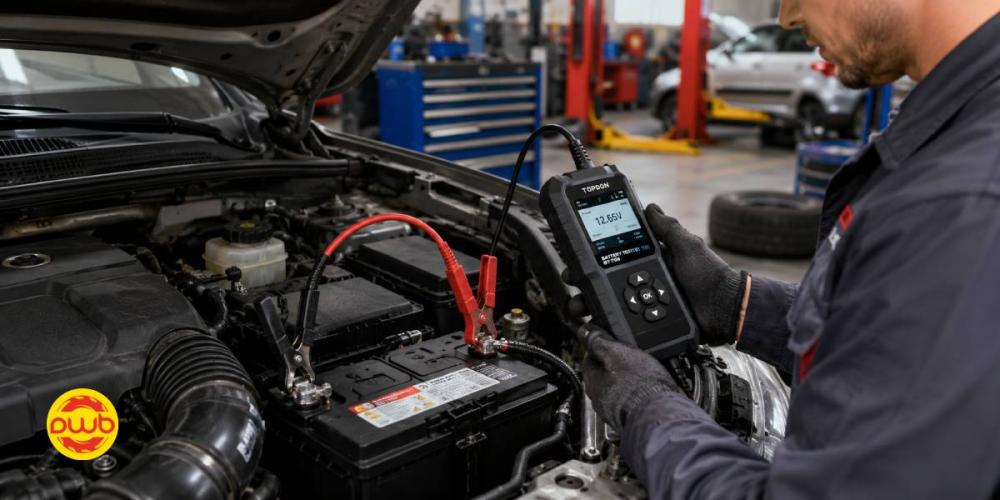
How Does a Garage Test the Battery and Alternator?
A professional diagnosis should check the system rather than replace parts based on symptoms alone.
1. Inspect the Battery
Look for:
- swelling;
- leakage;
- corrosion;
- loose terminals;
- damaged cables;
- and poor connections.
2. Check Battery State of Charge
Battery voltage gives useful information, but voltage alone does not prove the battery can deliver enough starting current.
3. Perform a Battery Conductance or Load Test
The battery should be tested to determine whether it can supply the required starting current under load.
4. Start the Engine and Check the Charging System
Once the engine runs, charging-system output can be measured.
A technician may monitor:
- charging voltage;
- charging current;
- system behaviour under electrical load;
- and voltage regulation.
Exact normal values depend on vehicle design.
Modern vehicles may use computer-controlled or smart charging strategies, so a single generic voltage number should not be used to diagnose every car.
5. Check Connections and Grounds
Poor connections can imitate both battery and alternator faults.
6. Check for Parasitic Drain if Necessary
If both battery and alternator test correctly but the battery repeatedly goes flat after parking, an electrical circuit may be drawing excessive current while the vehicle is switched off.
The next step is parasitic-draw diagnosis rather than another battery replacement.
Can I Test the Alternator by Disconnecting the Battery While the Engine Is Running?
Do not use this old test on a modern vehicle.
Disconnecting a battery terminal while the engine is running is sometimes described online as a quick way to test whether the alternator can keep the engine alive.
It is not a good diagnostic method for modern vehicles.
Removing the battery from the circuit while the charging system is operating can produce electrical instability and risks affecting sensitive electronic systems.
Use proper charging-system test equipment instead.
Why Does My Battery Keep Dying Overnight?
If the car starts normally after charging but repeatedly has a flat battery after being parked, consider three main possibilities:
Weak Battery
The battery may charge but no longer retain energy correctly.
Charging Problem
The alternator may never be fully restoring the battery during normal driving.
Parasitic Electrical Drain
Something continues consuming excessive power after the vehicle has been switched off.
Potential sources can include:
- aftermarket accessories;
- lights remaining active;
- faulty modules;
- relay problems;
- wiring faults;
- dash cameras;
- or other electrical equipment.
This is why replacing the battery without testing can fail to solve the problem.
When Is a Battery or Alternator Problem Urgent?
A difficult morning start is different from a charging failure developing while you are driving.
Arrange immediate inspection if:
- the battery/charging warning light comes on while driving;
- headlights and dashboard lights begin dimming;
- several electrical systems fail at once;
- the engine repeatedly stalls;
- you smell electrical burning;
- the battery is swollen or leaking;
- the battery gets unusually hot;
- or the car repeatedly needs jump-starting.
If the vehicle stalls and you suspect alternator failure, continuing the journey after another jump-start may leave you stranded again once the remaining battery power is consumed. AAA recommends towing when charging failure causes the warning light or stalling rather than assuming the car will continue running safely.
Battery or Alternator Problem? Test Before Replacing Parts
Do not buy another battery simply because the current one is flat.
Battery Keeps Dying?
Test the battery and charging system before replacing parts. A flat battery can be the result of the problem rather than the original cause.
Check Your Battery DWB provides a dedicated car battery replacement service in Abu Dhabi, and its battery service information also describes battery diagnosis and charging-system checks before or after replacement.
Battery vs Alternator: Quick Diagnostic Checklist
Engine cranks slowly before starting
→ Battery condition should be checked first.
Rapid clicking when you try to start
→ Low battery power or poor battery connection is possible.
One strong click but engine does not turn
→ Starter motor or starter circuit may be involved.
Starts with a jump and continues running
→ Battery becomes more suspicious, but check alternator output too.
Starts with a jump but quickly stalls
→ Charging-system or alternator failure becomes more likely.
Battery warning light is on while driving
→ Treat it as a charging-system warning.
Headlights flicker while engine is running
→ Alternator, wiring or ground fault may be involved.
New battery repeatedly goes flat
→ Test the charging system and check for parasitic drain.
Battery is swollen or leaking
→ Do not continue normal use or casually jump-start it; arrange professional inspection.
Battery and alternator both test correctly but battery dies overnight
→ Investigate parasitic electrical drain.
Frequently Asked Questions About Batteries and Alternators
Quick answers to common questions about battery failure, alternator problems and charging-system symptoms.
How can I tell if my battery or alternator is bad?
Slow starting, rapid clicking and a battery that will not hold charge often point toward the battery. Stalling after a jump-start, charging warnings and electrical problems while the engine is running make the alternator or charging system more suspicious. Testing is required to confirm the cause.
Will a car start with a bad alternator?
It can. If the battery still has enough charge, it may start the engine even when the alternator is failing. The vehicle may then develop electrical problems or eventually stall as battery power is depleted.
If my car starts with a jump, is the battery definitely bad?
No. A successful jump-start shows that additional electrical power helped start the vehicle, but the original cause could be a discharged battery, failing battery, charging problem or poor connection. Test the battery and alternator before replacing parts.
Why does my car start with a jump and then die?
If the engine starts after a jump but stalls shortly afterwards, the charging system may not be supplying enough electrical power once the external source is removed. Alternator and charging-system testing should be carried out.
Does the battery warning light mean I need a new battery?
Not necessarily. The battery-shaped warning light normally indicates a charging-system problem while the engine is running. The alternator, regulator, wiring, connections or other charging components may be responsible.
Can a bad alternator drain a new battery?
Yes. If the alternator does not recharge the battery correctly, even a new battery can gradually become discharged. Charging-system testing is important when batteries repeatedly go flat.
 Search Tyre