Search Tyre
Brake Disc Skimming
Suitable for minor surface wear when the disc is still above the manufacturer’s minimum thickness.
Lower Initial Cost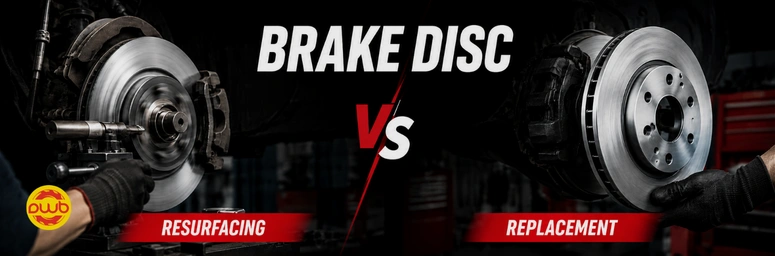
Brake disc skimming can be the right choice when the disc has only minor surface wear, light scoring or slight unevenness and still remains above the manufacturer’s minimum thickness. Replacement is the safer option when the disc is too thin, deeply grooved, cracked, heat damaged or no longer suitable for machining. In most cases, the correct decision in a brake disc skimming vs replacement comparison depends on the actual condition and measured thickness of the disc rather than cost alone.
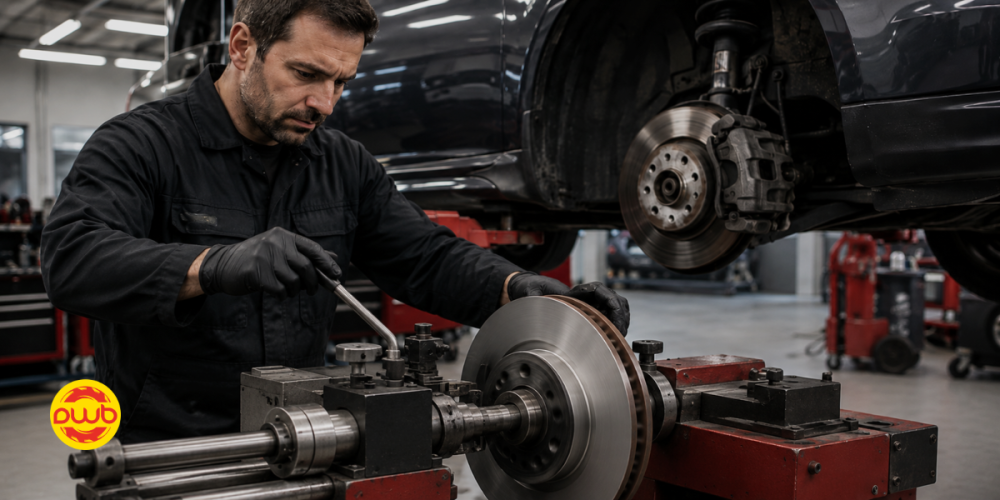
Brake discs gradually wear each time the brake pads press against them. Over time, this can create grooves, uneven surfaces or vibrations that are felt through the brake pedal or steering wheel. Skimming removes a very thin layer from the disc surface to restore a smoother and more even contact area for the brake pads. This may improve braking comfort and reduce vibration when the disc remains structurally sound.
However, skimming is not suitable for every damaged brake disc. Removing material from an already thin or badly worn disc can reduce its ability to manage heat safely. In these situations, fitting a new disc provides greater reliability and a longer usable life.
This guide explains how technicians assess brake disc condition, when skimming is reasonable, when replacement is necessary and which factors affect the final decision. Understanding brake disc skimming vs replacement helps drivers avoid unnecessary work while ensuring that braking performance and safety are not compromised.
Suitable for minor surface wear when the disc is still above the manufacturer’s minimum thickness.
Lower Initial CostRecommended for thin, cracked, deeply grooved or heat-damaged discs that cannot be machined safely.
Better Long-Term ReliabilityThe right option should be confirmed after measuring the disc thickness and inspecting its condition.
The better option depends on how much usable material remains on the disc and the type of damage found during inspection. In a brake disc skimming vs replacement decision, skimming is usually more suitable when the disc is still thick enough, structurally sound and affected only by light surface problems. Replacement becomes the better choice when wear or damage has reached a level that machining cannot correct safely.
For example, a disc with mild scoring, surface rust or slight unevenness may be suitable for skimming. The technician removes a controlled amount of metal to create a flat contact surface for the brake pads. Before starting, the disc thickness must be measured and compared with the minimum value specified by the vehicle manufacturer. Enough material must remain after machining for the disc to continue managing braking heat effectively.
Replacement is normally required when the disc has deep grooves, visible cracks, severe corrosion, blue heat spots or excessive thickness variation. It is also preferable when the disc is close to its minimum thickness, even if the surface initially appears repairable. Skimming a disc in this condition may provide only a temporary improvement while reducing its remaining service life.
Vehicle use also affects the final choice. Cars driven regularly in heavy traffic, carrying high loads or exposed to repeated hard braking place greater thermal stress on their brake discs. In these situations, replacement may offer more consistent performance. A proper brake disc skimming vs replacement assessment should therefore consider measurements, damage, driving conditions and expected service life together.
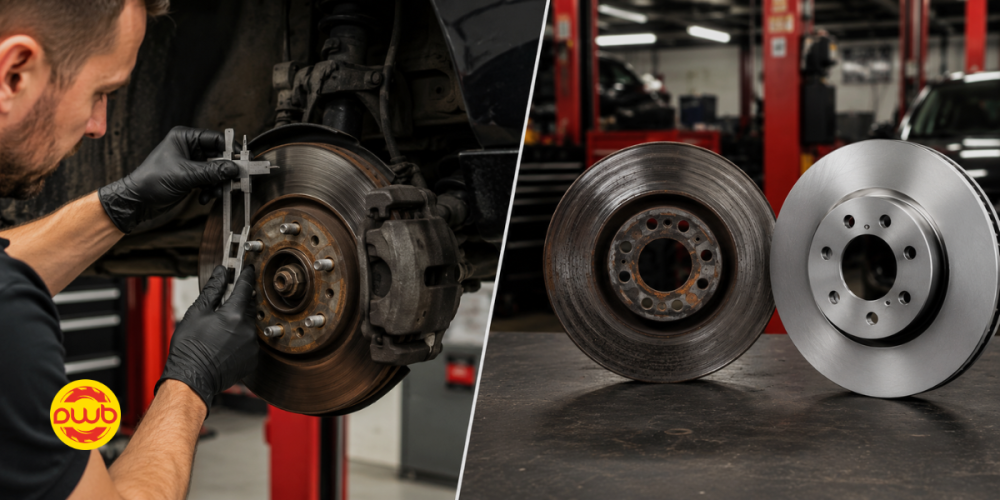
A reliable brake disc skimming vs replacement decision cannot be made by looking at the disc surface alone. A qualified technician should measure its thickness at several points, inspect it for cracks and heat damage, and check whether enough material will remain after machining. Brembo states that the lowest measurement should be compared with the minimum thickness marked on the disc, and replacement is required when the disc has reached or fallen below that limit.
Although skimming may correct minor scoring or surface variation, it also has disadvantages. Every machining process removes metal, reducing the disc’s remaining thickness and its ability to absorb and release braking heat. Poorly adjusted equipment may produce an uneven finish, fail to correct disc runout or leave a raised lip around the outer edge. This lip can interfere with proper pad contact and may contribute to noise or uneven wear. For this reason, skimming is not automatically the most technically appropriate solution simply because it costs less than fitting new discs.
The quality of the equipment and the technician’s measurements are therefore essential. A professional Car Brake Service in Dubai should check the manufacturer’s specifications rather than recommending skimming based only on visible grooves or steering vibration. Bosch also recommends measuring disc thickness at multiple points because wear may not be uniform across the entire surface.
In a trustworthy brake disc skimming vs replacement assessment, safety, remaining service life and braking stability should take priority over the lowest immediate repair cost.
Contact DWB Tyres for a professional brake inspection and clear advice based on the condition, thickness and wear level of your brake discs.
Choosing between brake disc skimming vs replacement becomes easier when the decision is based on condition, cost, safety and expected service life. Skimming may reduce vibration and improve pad contact when the disc has minor surface wear and enough thickness remains. However, it removes part of the disc material, so the result may not last as long as a new disc, especially when the vehicle is used in heavy traffic or exposed to frequent braking.
Replacement costs more initially but provides a new braking surface with full thickness and greater heat capacity. It is usually the more suitable choice when the disc has deep grooves, cracks, severe corrosion, heat damage or measurements close to the minimum limit. New discs can also provide more consistent contact with new brake pads and reduce the risk of the same vibration returning shortly after repair.
Skimming usually has a lower initial cost but a shorter remaining service life.
Replacement is more suitable for thin, cracked or heavily damaged discs.
Skimming requires accurate measurement before and after machining.
Replacement normally provides better long-term reliability under demanding driving conditions.
The best brake disc skimming vs replacement choice is not always the cheapest option or the most extensive repair. A lightly worn disc may not need immediate replacement, while a badly damaged disc should not be skimmed simply to reduce cost. Asking the technician to explain the measured thickness, visible damage and expected lifespan helps the driver understand the recommendation and make a more informed decision.
The final decision in a brake disc skimming vs replacement comparison should be based on the condition of the disc, its measured thickness, the type of damage and how the vehicle is used. Skimming can be a reasonable option when the disc has minor surface wear, remains safely above the manufacturer’s minimum thickness and has no cracks or serious heat damage. Replacement is the better choice when the disc is thin, deeply grooved, heavily corroded, cracked or likely to provide only a short service life after machining.
Drivers should not choose skimming only because it appears cheaper. Removing metal from the disc reduces its remaining thickness, and an incorrect machining process may leave an uneven surface or raised edge. At the same time, replacing every disc without inspection can create unnecessary expense. A proper brake assessment helps avoid both problems.
The purpose of this guide is to provide a clear and practical answer rather than repeat keywords without useful information. A reliable brake disc skimming vs replacement decision should always prioritise safety, braking stability and long-term value. Dwbtyres can inspect the braking system, measure the discs and recommend the most suitable option based on their actual condition.
Clear answers to common questions about brake disc condition, skimming, replacement, safety and choosing the right repair for your car.
Neither option is always better. Skimming may be suitable when a disc has minor surface wear, no structural damage and enough thickness remaining. Replacement is generally safer for thin, cracked, deeply grooved or heat-damaged brake discs.
The disc must be inspected and measured at several points. Skimming should only be considered when the disc will remain above the manufacturer’s minimum thickness after machining and has no cracks, severe corrosion or serious heat damage.
Skimming may help when vibration is caused by minor surface variation or uneven contact between the brake pads and disc. However, vibration can also come from damaged hubs, worn suspension parts, wheel installation problems or tyre issues, so the cause should be properly diagnosed first.
Skimming removes metal and reduces the remaining thickness of the disc. Incorrect machining may also leave an uneven surface or raised outer edge. A disc that is already close to its minimum thickness may have a limited service life after skimming.
New brake pads are often recommended because used pads may have worn to match the previous disc surface. Installing suitable new pads can provide more even contact with the machined disc and reduce the risk of noise, vibration and uneven braking.
Driving with badly worn or damaged discs may reduce braking consistency, increase stopping distance and damage other braking components. Arrange an inspection if you notice grinding sounds, strong vibration, weak braking response or visible disc damage.