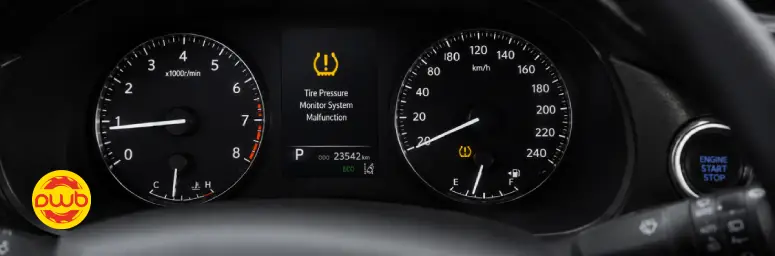
A solid low-pressure warning and a malfunction indication should not be treated as the same problem. NHTSA notes that a system malfunction may be indicated when the TPMS symbol flashes for roughly 60–90 seconds and then remains illuminated. Exact behaviour can vary by vehicle, so the owner’s manual remains the final reference for that model.
Why Is My TPMS Light On?
A TPMS warning does not identify the exact cause by itself. It tells you that tyre pressure or the monitoring system needs attention.
These are the most common possibilities.
1. Low Tyre Pressure
The first thing to check is tyre pressure.
A tyre naturally loses some air over time, and even a modest pressure loss can eventually take the tyre below the TPMS warning threshold.
Do not inflate the tyre based on the number printed as the maximum pressure on the tyre sidewall.
Instead, use the recommended cold tyre pressure specified by the vehicle manufacturer, normally found on the vehicle information label or in the owner’s manual. Michelin and Toyota both recommend checking against the manufacturer's cold-pressure specification.
You can also read our guide to under-inflated tyres to understand how low pressure affects tyre performance, wear and vehicle behaviour.
2. A Puncture or Slow Air Leak
If one tyre repeatedly loses pressure after inflation, adding more air is not a repair.
A slow leak may come from:
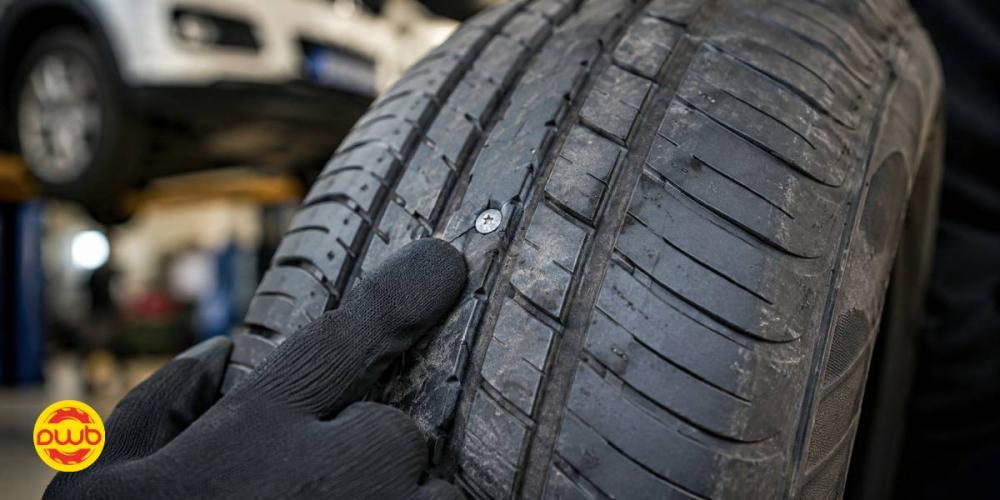
- a nail or screw in the tread;
- a leaking valve or valve core;
- damage around the tyre bead;
- wheel or rim damage;
- or tyre damage that allows air to escape gradually.
Some leaks are slow enough that the car can be parked overnight before the warning returns. Others become worse while driving.
If the same tyre keeps dropping below its normal cold pressure, it needs inspection rather than repeated inflation.
A professional car tyre service in Abu Dhabi can check tyre pressure and inspect the tyre and wheel for the cause of air loss. DWB's tyre service page includes tyre-pressure checking as part of professional tyre assessment.
3. Temperature Changes
Temperature changes affect tyre pressure, but this is commonly explained incorrectly.
Hot weather does not normally make the air pressure inside a tyre fall. As tyre and air temperature increase, pressure generally rises. When temperature falls, tyre pressure decreases.
This matters in the UAE because a tyre checked after driving on a hot road can show a noticeably different pressure from the same tyre when cold.
For that reason, do not release air from a hot tyre simply because its pressure is higher than the vehicle's specified cold pressure. Michelin specifically recommends checking when tyres are cold and warns against deflating a warm tyre to reach a cold-pressure target.
If a tyre is already close to the TPMS warning threshold, a cooler morning can also be enough to trigger the warning. The underlying pressure should still be checked rather than assuming temperature is the only cause.
4. A Faulty TPMS Sensor or System
Sometimes all four tyre pressures are correct but the warning remains.
With direct TPMS, possible issues can include a sensor that is no longer communicating correctly, a sensor or valve assembly problem, or a system that has not correctly recognised a wheel or sensor after service.
With indirect TPMS, the system may require recalibration after tyre pressure adjustment or certain wheel/tyre work.
A flashing warning followed by a continuously illuminated light is an especially important clue because it may indicate that the monitoring system itself is malfunctioning.
5. Tyres or Wheels Were Recently Changed
If the warning started after new tyres, wheel replacement, rotation or TPMS-related work, the pressures should still be checked first.
After that, consider whether the vehicle requires TPMS initialisation, calibration or sensor relearning.
There is no single relearn process that applies to every manufacturer. Some vehicles identify sensors automatically. Others require a menu procedure, reset operation or diagnostic equipment.
This is why copying a generic TPMS reset procedure from another vehicle is not recommended.
Solid vs Flashing TPMS Light: What Is the Difference?
The behaviour of the warning light provides an important diagnostic clue.
What Should You Do When the TPMS Light Comes On?
Start with the tyre, not the reset button.
Step 1: Pay Attention to How the Car Feels
If steering suddenly feels unstable, the vehicle pulls strongly, you hear repeated thumping or a tyre appears very low, reduce speed safely and stop as soon as possible.
Do not continue driving simply because the warning light is the only dashboard alert.
Step 2: Visually Inspect All Tyres
Look for:
- a visibly deflated tyre;
- nails or screws;
- sidewall cuts;
- bulges;
- major tread damage;
- or obvious wheel damage.
A visual inspection is useful, but it does not confirm correct tyre pressure.
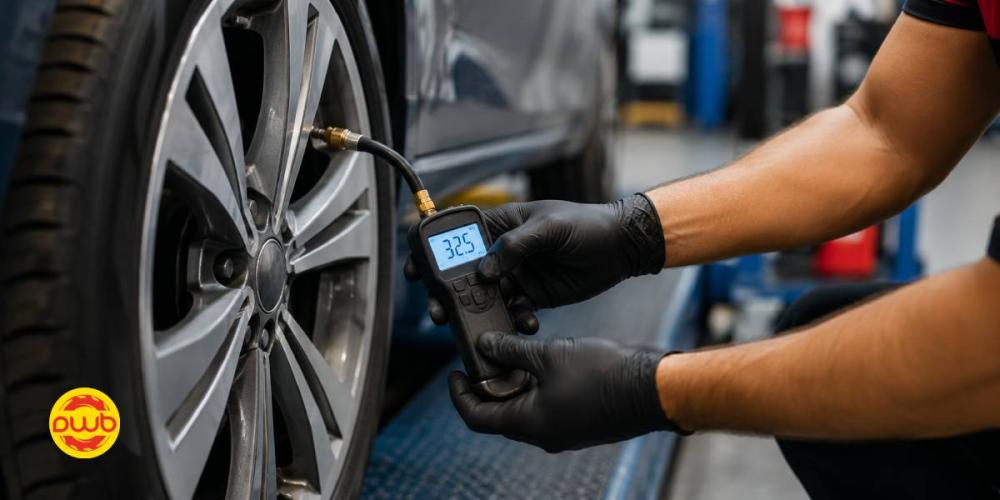
Step 3: Measure the Pressure
Use a reliable pressure gauge.
Ideally, measure the tyres cold — before significant driving or after the vehicle has been parked long enough for the tyres to cool.
Compare each reading with the pressure specified by the vehicle manufacturer.
Do not use the tyre sidewall's maximum-pressure marking as the normal operating pressure.
Step 4: Correct the Pressure
If a tyre is low and there is no obvious damage preventing safe inflation, adjust it to the manufacturer's specified cold pressure.
Check all four tyres rather than only the tyre you suspect.
Some vehicles also monitor a full-size spare, depending on the TPMS design.
Step 5: Check Whether the Warning Clears
Some vehicles update the warning automatically after the pressures are corrected and the vehicle is driven.
Others may require an initialisation, reset or relearn procedure.
Do not assume the system needs resetting simply because the light remains on immediately after inflation.
Step 6: Investigate Repeated Pressure Loss
If the warning disappears after inflation but returns again, the key question is:
Which tyre lost pressure, and why?
Repeated pressure loss is evidence that the cause has not been solved.
Why Is My TPMS Light Still On After Inflating the Tyres?
If you have already added air but the TPMS warning remains on, there are several possible explanations.
The Pressure Is Still Incorrect
The most basic cause is also easy to overlook.
The tyre may have been inflated using:
- an inaccurate gauge;
- the wrong PSI target;
- a hot tyre reading;
- or the tyre sidewall maximum instead of the vehicle specification.
Recheck all tyres cold using a reliable gauge.
One Tyre Has a Slow Leak
A punctured tyre can be inflated successfully and still lose pressure again.
If the warning clears and returns later, record the cold pressures of all four tyres. A tyre that consistently drops compared with the others should be inspected for leakage.
The System Has Not Updated Yet
Some TPMS systems need the car to be driven before new pressure information is recognised.
The exact driving distance, speed or reset process is vehicle-specific, so follow the owner's manual rather than a universal online reset method.
TPMS Initialisation May Be Required
Indirect TPMS systems commonly need calibration after tyre pressure adjustment or other tyre-related work.
Some direct systems may also require sensor registration or relearning after wheel or sensor changes.
There May Be a TPMS Fault
If the light flashes before remaining illuminated, or pressure values are unavailable or obviously incorrect, the monitoring system may need professional diagnosis. NHTSA identifies a flashing-then-continuous warning as a possible TPMS malfunction indication.
How Do You Reset the TPMS Light?
There is no universal TPMS reset procedure that works for every car.
This is important.
Depending on the vehicle, the system may:
- reset automatically after pressure correction;
- require driving for the new readings to register;
- have a TPMS reset or initialisation option in the vehicle menu;
- require a physical reset procedure;
- require indirect TPMS calibration;
- or need TPMS diagnostic/relearn equipment after sensor replacement.
Before resetting anything, first make sure all tyre pressures are actually correct.
Resetting an indirect TPMS while one tyre is incorrectly inflated can teach the system the wrong baseline.
The safest procedure is to follow the TPMS section of the vehicle manufacturer's owner’s manual.
Can You Drive With the TPMS Light On?
You should not ignore a TPMS warning light.
Whether the vehicle can be moved safely depends on the actual tyre condition, not simply whether the warning is yellow rather than red.
If the tyres appear normal, the steering feels normal and a pressure check confirms that the tyres are safe, the car may be able to continue normally after the underlying pressure issue is corrected.
However, driving should be stopped if you find:
- a visibly flat tyre;
- rapid pressure loss;
- a tyre bulge;
- serious sidewall damage;
- strong vibration;
- unstable steering;
- repeated heavy thumping;
- or obvious wheel damage.
Underinflation increases tyre flex and heat generation, which can increase the risk of tyre damage if driving continues. Continental notes that reduced inflation pressure increases tyre strain and heat buildup.
The TPMS warning therefore should be treated as an instruction to check, not as something to hide by pressing reset.
Why Does My TPMS Light Come On in the Morning and Go Off Later?
Temperature can explain this pattern.
When the outside temperature decreases overnight, tyre pressure decreases. If a tyre is already close to the system's warning threshold, the lower morning pressure may switch the TPMS light on.
After driving, tyre temperature and pressure rise, so the warning may disappear.
This does not mean you should ignore it.
A tyre that repeatedly sits near the warning threshold may simply be underinflated when cold, or it may have a slow air leak.
Check the pressures when the tyres are cold and adjust them to the vehicle manufacturer's specification. Michelin notes that pressure decreases as temperature falls, while Toyota confirms that increased temperature raises tyre pressure.
Does Dubai Heat Cause the TPMS Light to Come On?
Not in the simple way many drivers assume.
High ambient temperature and driving on hot UAE roads generally increase tyre temperature and therefore increase pressure. The more important problem is comparing a hot tyre reading with a cold-pressure specification.
For example, a driver may check the tyre after a long journey, see a higher PSI number and release air. Once the tyre cools, it may then be underinflated.
For this reason, Michelin advises against deflating warm tyres simply to reach the specified cold pressure.
In Dubai and the wider UAE, the practical rule is simple:
Use cold tyre pressure as your baseline and do not adjust pressure simply because a hot tyre shows a higher reading.
Does TPMS Replace Manual Tyre Pressure Checks?
No. TPMS is a warning system, not a replacement for routine pressure checks.
The system is designed to alert the driver when pressure reaches a warning condition. It does not mean every tyre is at its ideal pressure whenever the light is off.
Bridgestone specifically advises that TPMS should not replace regular tyre-pressure maintenance, while Michelin recommends routine checks using a reliable pressure gauge.
A tyre can therefore be below its ideal specification without necessarily producing an immediate warning.
Regular manual checks remain important, especially before long journeys.
Can a TPMS Sensor Detect a Puncture?
Not directly.
A TPMS is primarily monitoring pressure or pressure-related wheel behaviour. It does not inspect the tread and identify a nail, screw or cut.
If a puncture causes enough air loss, TPMS may eventually warn you about the pressure loss caused by the puncture.
That distinction matters.
A small nail can remain in the tread while the tyre loses air slowly. The warning might not appear at the exact moment the tyre is punctured.
So if you find an object in the tread, do not assume the tyre is safe simply because the TPMS warning has not appeared.
Can You Tell Which Tyre Has Low Pressure?
It depends on the vehicle.
Some direct TPMS systems display individual tyre pressures or identify the affected tyre on the instrument cluster.
Other vehicles provide only the general TPMS warning symbol.
Indirect systems may also provide less specific pressure information because they infer a problem from wheel behaviour rather than directly measuring pressure inside each tyre.
If the dashboard does not identify the tyre, check all four with a pressure gauge.
Should You Replace a TPMS Sensor When Changing Tyres?
Not automatically.
Changing a tyre does not by itself mean every TPMS sensor needs replacement.
However, if the vehicle uses direct TPMS, the sensor and valve assembly should be handled correctly during tyre removal and installation.
If a sensor is damaged, malfunctioning or no longer communicating correctly, replacement may be necessary.
After replacement, the new sensor may also need to be registered or relearned by the vehicle.
A flashing TPMS warning after tyre or wheel work should therefore be diagnosed rather than automatically blamed on tyre pressure.
Is Your TPMS Light Staying On?
If the pressure has been corrected but the warning keeps returning, the next step should be identifying the cause — not repeatedly adding air or resetting the dashboard.
 Search Tyre